
WHAT YOU NEED TO KNOW
The mathematical reality of roulette is that every bet is governed by a fixed casino advantage, meaning no strategy can alter the physics of the wheel or the probability of where the ball lands.
- European roulette features a single green zero, resulting in a 2.70% house edge on all standard bets.
- American roulette adds a double zero, which almost doubles the casino advantage to 5.26%.
- Payouts range from 35 to 1 for a single-number bet down to 1 to 1 for even-money outside bets like red or black.
- No betting progression can bypass these mathematical limits, making bankroll management your only real defense.
Having the roulette odds explained clearly is the best way to understand how your choice of wheel affects your mathematical chances.
Roulette Odds Explained: American vs. European Wheels
How do the two main variations of the game differ in terms of probability? The standard European wheel has 37 pockets, numbered 1 to 36, plus a single green zero (0). The American wheel contains 38 pockets because it adds a double zero (00). This tiny structural adjustment has a massive impact on your chances of winning over time.
When we analyze roulette odds, we look at the mathematical probability of a ball landing on your chosen selection. On a European wheel, a single-number bet has a 2.70% chance of success. On an American wheel, that same bet drops to a 2.63% chance due to the extra pocket. Understanding these percentages helps you make informed decisions before putting any chips on the layout.
The layout differences can be summarized by these basic structures:
- European Wheel: 37 total pockets, 18 red, 18 black, and 1 green zero.
- American Wheel: 38 total pockets, 18 red, 18 black, and 2 green zeros (0 and 00).
- French Wheel: Same 37-pocket layout as European, but often includes favorable rules like La Partage or En Prison which can halve the house edge on even-money bets.
Inside Bets: Odds and Payouts
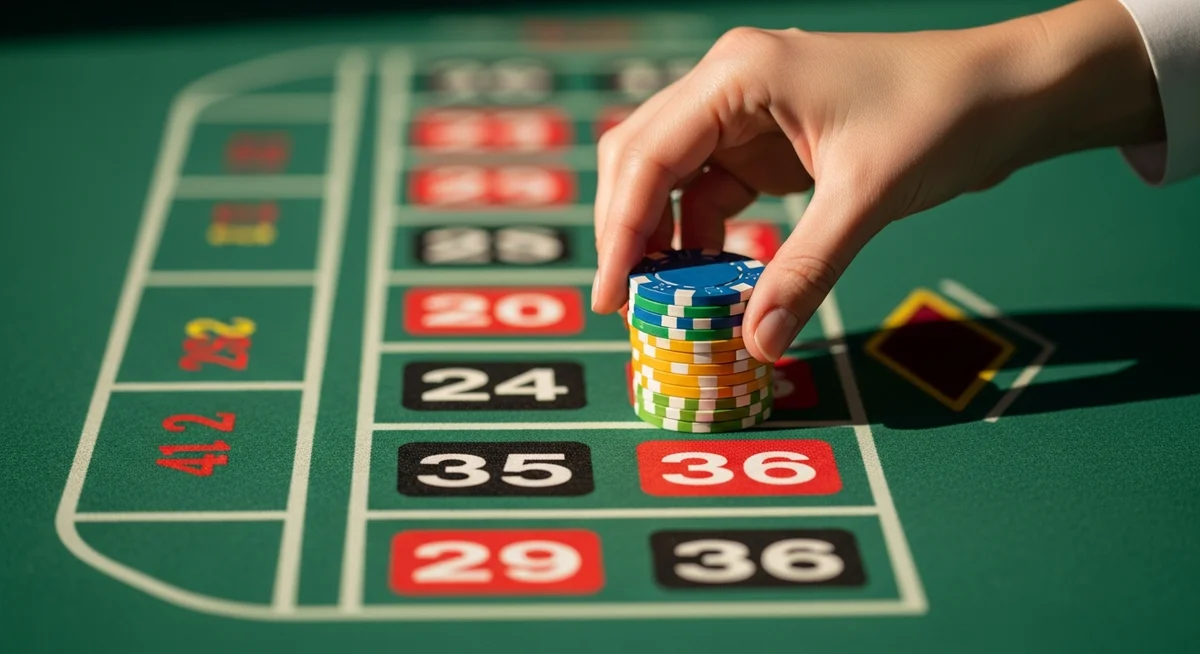
Inside bets are placed on the inner section of the table grid. These bets target specific numbers or small clusters of adjacent numbers. While they offer much higher payouts, they also carry a lower mathematical probability of winning on any given spin.
Straight Up (Single Number)
A Straight Up bet is a wager on any single number on the board. If the ball lands on your exact number, the payout is 35 to 1. The actual mathematical odds of winning are 1 in 37 (2.70%) on a European wheel and 1 in 38 (2.63%) on an American wheel.
Split and Street Bets
A Split bet allows you to wager on two adjacent numbers by placing a chip on the line sharing them, offering a 17 to 1 payout. The probability of winning a Split bet is 5.41% on European wheels and 5.26% on American setups.
A Street bet covers three consecutive numbers in a row, such as 1, 2, and 3, by placing a chip on the outer boundary line of that row. This bet pays 11 to 1, with winning probabilities of 8.11% in European games and 7.89% in American variations.
Corner and Basket Bets
A Corner bet covers four intersecting numbers on the grid. It offers an 8 to 1 payout, with a winning probability of 10.81% on European wheels and 10.53% on American wheels.
The Basket bet, also known as a five-number bet, is exclusive to American roulette and covers the numbers 0, 00, 1, 2, and 3. It pays 6 to 1 but carries a highly unfavorable probability of 13.16%.
Line Bets
A Line bet covers six numbers across two adjacent rows. Players place their chips at the intersection of the two rows along the outer border. This option pays out at 5 to 1, offering a winning probability of 16.22% in European roulette and 15.79% in American roulette.
Outside Bets: Odds and Payouts
Outside bets are positioned around the perimeter of the betting layout. They cover broader categories of numbers, which makes them highly popular for players seeking more frequent, lower-risk payouts. Because they cover a larger portion of the wheel, the payouts are lower than inside bets.
Red or Black, Even or Odd, High or Low
These are the classic even-money wagers in roulette, each paying out at 1 to 1. A winning bet simply doubles your stake on the table. On a European wheel, the probability of winning any of these bets is 48.65%. On an American wheel, the presence of both green zeros lowers your winning probability to 47.37%.
Dozens and Columns
Dozens and Columns allow you to bet on 12 numbers at once, paying out at 2 to 1. Dozens break the board down into three sections (1 to 12, 13 to 24, and 25 to 36), while Columns cover 12 vertical numbers. The probability of winning either of these bets is 32.43% on a single-zero wheel and drops to 31.58% on a double-zero layout.
Complete Roulette Odds and Payouts Chart
To help you compare your options at a glance, this roulette payout chart outlines the key numbers for both wheel styles. Knowing these figures allows you to align your betting selections with your personal risk tolerance and budget.
| Bet Type | Payout | European Probability | American Probability |
|---|---|---|---|
| Straight Up (1 Number) | 35 to 1 | 2.70% | 2.63% |
| Split (2 Numbers) | 17 to 1 | 5.41% | 5.26% |
| Street (3 Numbers) | 11 to 1 | 8.11% | 7.89% |
| Corner (4 Numbers) | 8 to 1 | 10.81% | 10.53% |
| Line Bet (6 Numbers) | 5 to 1 | 16.22% | 15.79% |
| Column / Dozen (12 Numbers) | 2 to 1 | 32.43% | 31.58% |
| Red / Black / Even / Odd | 1 to 1 | 48.65% | 47.37% |
Understanding the House Edge in Roulette
What makes the game structurally favor the casino? According to the UK Gambling Commission, understanding the mathematical advantage of casino games is a core component of safe play. The roulette house edge represents the average percentage of all wagers that the casino expects to retain over the long term.
The Malta Gaming Authority emphasizes that licensed operators must clearly display the return-to-player percentages, which are directly tied to this house edge. By understanding how these calculations work, you can avoid common misconceptions about how the game pays out.
How the Green Zero Favors the Casino
The house edge is the mathematical advantage that the casino holds over players, and in roulette, this edge is entirely created by the green zero pockets. If there were no zeros on the wheel, a red or black bet would have a perfect 50% chance of winning, resulting in a zero house edge. Because of the green zero, a red bet on a European wheel actually has an 18 in 37 chance of winning, which is 48.65%. The casino pays even money as if the odds were 50/50, keeping the remaining percentage as their statistical advantage.
The Roulette Bet with the Worst Odds
Not all roulette bets are created equal when it comes to the house advantage. In American roulette, the Basket bet (covering 0, 00, 1, 2, and 3) carries a massive 7.89% house edge. This is significantly worse than the standard 5.26% house edge found on all other American roulette bets. Experienced players generally avoid the Basket bet due to this mathematically poor return, preferring bets that maintain the lower standard edge.
Do Betting Strategies Change the Odds?
Many players turn to popular betting systems like the Martingale, Fibonacci, or D’Alembert in an attempt to secure regular wins. However, no betting strategy can alter the mathematical roulette house edge or shift the underlying probabilities of the game. Every spin of the wheel is an independent event, meaning the wheel has no memory of past results.
GambleAware, a leading responsible gambling education body, constantly reminds players that systems cannot guarantee profits and should never be viewed as a way to generate income. Instead of chasing losses with risky betting progressions, players should rely on safe bankroll management and clear limits to keep the game safe and enjoyable. Setting strict time and loss limits is the most effective way to maintain control over your session.